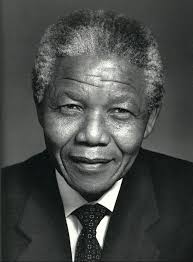
I just read Sisonke Msimang’s wonderful article, Rescuing Nelson Mandela from Sainthood. It reminded me of thoughts I had when I read William Gumede’s Thabo Mbeki and the Battle for the Soul of the ANC earlier this week.
My thoughts weren’t about Mbeki or the ANC. They were about Nelson Mandela, and how he is remembered by most South Africans today.
I’ve heard of many documentaries, many books, many people who speak about how Nelson Mandela sold us out during the negotiations in the early 1990s. They point to a failure to implement socialism as our main economic system and instead followed the “neoliberal brigade” as proof that the whites did us dirty and Mandela allowed it because he wanted to be the most famous African in the world.
They point to the Truth and Reconciliation Commission (TRC) and how it did not bring justice to those who lost family members to the anti-apartheid struggle and Mandela allowed it because he wanted to be the most famous African in the world.
They point to the cases of anti-black racism that have seen an upswell in the past few years and express anger at how apartheid doesn’t seem to be over – there are still more black people living in extreme poverty, and yet that still isn’t enough for certain white people who will spit out the k-word with reckless abandon because they know we’re still powerless 25 years after the fact. And Mandela allowed it because he wanted to be the most famous African in the world.
I disagree. Not with the facts of the RDP and GEAR, not with the facts of the travesty that was the TRC, not with the very real feeling that the negotiations were more an opportunity for those complicit in apartheid to guarantee their futures than give a damn about those who were disadvantaged.
I disagree with the seemingly-obvious implications: that one Nelson Mandela passively let these facts come to be, because of a desire to be revered and mythologised.
Just as we cannot discount international disinvestment as one of the reasons the National Party went to the negotiating table, one also cannot discount international change as one of the reasons the African National Congress couldn’t bring about its own systems wholesale. The Cold War had, for all intents and purposes, ended. Socialism as a national economic system fell when the Berlin Wall did. And based on the dire financial straits that South Africa was in, they needed investments. And guess who had the capacity to invest?
Yes, the Western world, with their capitalism.
And so Mandela’s party went with the option that would bring investment, bring economic growth, bring options to the downtrodden among us.
Did he betray the oft-cited principles of the ANC?
Yes, and wisely so.
We wouldn’t currently have the second-largest economy in Africa if that wasn’t the case. We might not even have the vast social grant system we have today. The rollout of free ARVs to millions of South Africans in public clinics – that likely wouldn’t be the case.
Why aren’t we higher up in the economic order of things? Blame the ANC that came after Mandela. Specifically, blame the ANC of Jacob Zuma and his nine wasted years. Blame the state capture project that seemingly had no state capturers.
For people to laud Robert Mugabe for running the Zimbabwean economy into the ground and lambasting Nelson Mandela for doing the exact opposite to the South African economy speaks volumes. There’s hypocrisy, sure. But there’s also pain there.
Many black people living among us wish that Mandela would’ve told the likes of John Major and Bill Clinton to keep their West, and he’d keep his South Africa. But he didn’t – and when one does a cost-benefit analysis, it was largely to our collective benefit.
What was not to our collective benefit was the TRC, and how it utterly failed in branding out justice to those who were murdered in the midst of a decades-long war against apartheid. Even so, I understand Madiba’s reasoning, even as the thought of the TRC sickens me.
People don’t go confessing to crimes, most of all murder. Those at the helm of the apartheid regime weren’t saints. Their moral compasses – if they had any at all – were pointed only at themselves and the advancement of their own kind. The advent of democracy wouldn’t change this. They’d remain with their distorted Afrikaner nationalism unless and until they chose to change this. Many didn’t.
Meanwhile, some black South Africans had lost dozens of family members to Umkhonto weSizwe, to the struggle, to One Person, One Vote. And while Mandela was sworn in as president, they still didn’t know what happened. “Where are my father’s remains?” “How did my husband die?”
Questions like these can haunt an individual for life. Add that to the very real feeling of economic discontent, and a recipe for psychological turmoil begins making itself.
To obtain this information, the TRC was formulated. Tell the truth, bare out your soul, and receive amnesty from the law.
Does it fly in the face of a natural desire of justice?
Absolutely.
But it does something else. It allows people to know where their loved ones’ remains are. It allows people to contextualize the stories of so many South Africans in a substantive way. It allows people to look their husband’s killer in the eye and know the full story. It ends the uncertainty.
Forgiveness is too big an ask. But it sets the wheels in motion for acceptance; closure; healing. And despite all the flaws that came along with it, Nelson Mandela, along with Archbishop Desmond Tutu, facilitated this process.
The process of “swart gevaar” never quite ended, though. While some white South Africans grapple with the legacy of apartheid, others still believe that the symbolism of monkeys is permissible to describe black South Africans. This is an unfortunate reality, but one that should not be placed at Mandela’s door.
As humans, we have the capacity for metacognition. In other words, we can think about our thoughts. We can choose to embrace our musings of hatred, or we can choose to overcome these. We can choose to spittle off every evil thought in our minds, or we can choose to reflect on why we believe that hurting others will miraculously heal us.
Point being, as human beings, we can choose what we think about.
More formally – as individuals living in a constitutional democracy, we have the freedom of choice. Some of us will choose as wisely as we can muster, some of us will not.
Blaming another individual – especially one that laid bare his individual values to the world like Mandela did – does not do the job of holding a Penny Sparrow or a Vicky Momberg accountable. It merely shifts the game from “your choices are yours” to “if you’re feared enough, then they will respect you”. Funny enough, that was the predominant tool in the apartheid regime’s arsenal: fear.
They scared white South Africans with the threat of black people populating cities (the horror!). They scared dissenting black South Africans with violence.
With democracy, we can and should do better. Violence indeed made South Africa ungovernable, but it was dialogue that led to the historic elections on this day 25 years ago. Fear may paralyze us into inaction, but it is only courage that leads to the bravest actions me, you and everybody around us celebrate today.
Are we courageous enough to let Penny and Vicky fall on their own swords? Or will we absolve them of their words, shouting at Mandela to strike fear into their hearts and let the cycle begin anew?
It is only up to us.
To be clear, Nelson Mandela was not a perfect human being. He was not even a perfect politician.
But in our binary conceptions of “saint-or-devil”, we lose the nuance that defined not only Nelson Mandela’s life, but our lives as well.
We’re not all good. We’re not all evil, either. We are human beings attempting to live each day the best way we know how to.
Some days we deserve praise. Some days we deserve punishment. Mandela had more than his fair share of both. But the error in our thinking is to think that Nelson Mandela was the end of our freedom project. He wasn’t. He (and many others) was only the beginning.
But that beginning was so monumental, so important, so unlikely at the outset that it deserves to be celebrated. And critiqued with kindness and generosity where it fell short. And continued to its only likely conclusion: a South Africa where all who live in it are truly free.
Free from hatred, free from pain, free from discrimination, free from poverty, free from low confidence and no self-esteem, free from ignorance, free from fear.. free from all those components that seek to keep us in a constant state of apart-heid.
Let us continue upon that long walk today, tomorrow, and always.
#ThankYouMadiba
 wiseMusings
Leave a comment