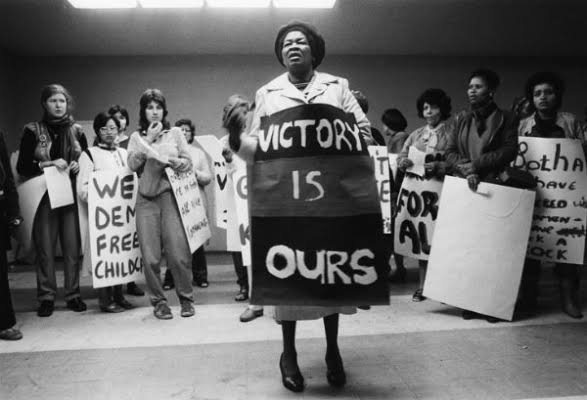
 Social movements are the best and worst thing to happen in world politics.
They are good, because they have given people an opportunity to publicly stand for what they believe in. They advance causes which are important to them, and attempt to get others to see their importance as well. They are bad, because they give others in said movements the false idea that the creation, and subsequent popularity, of a social movement is the beginning and end of the aims of a social movement.
For instance, I once had a disagreement with a person on The Twitter Sewer regarding an article I had written, urging people to vote during the 2019 general elections. The person disagreed with that view, stating that voting changes nothing institutionally. I replied by saying that institutional change won’t miraculously come about, and that we should use our votes to steer the political scene into a scene that better reflects our interests. The person then placed #FeesMustFall in the discussion, saying that that was a social movement that brought about institutional change without Parliament as a gatekeeper. I then informed the person that then-President Jacob Zuma announced that there would be free tertiary education for poor and working-class students, and that the Presidency is a political institution. A few non-sequitors later, and I bounced out. The person and I were speaking past each other, and it was of no value to go further.
My main point is that social movements, on their own, cannot create institutional change. They can create the rumblings for institutional change. They can necessitate institutional change. But they cannot bring that change to our doorsteps without the buy-in of the institutions themselves. Political institutions, in particular, are required to take our interests into account. It is their literal mandate.
Social movements do that quite well. You can ignore one person. You can ignore five people. You might even be able to ignore ten people. But you cannot ignore thousands of people signing petitions, writing letters of complaint, speaking to the media, protesting, and so on. By sheer force of quantity, social movements can give voice to a group that has been under-represented within political institutions. That isn’t even getting into the intellectual power that such movements can yield over said political institutions.
But let us not confuse that with actual change. Media coverage and thousand-person protests is not the success of a social movement, unless their mandate was specifically limited to such. It is the actual change in the plans of the establishment – Zuma announcing free tertiary education, De Klerk announcing the release of Nelson Mandela from prison – that mark the success of a social movement.
My problem with the Twitter person’s argument was their belief that politics was separate from the success of their movement, when their movement couldn’t have been successful without politics.
Does that render social movements that did not achieve their intended, specific purpose useless?
No.
These movements were important, if only because they documented the existence of a group that saw a major flaw in the status quo and publicly challenged it. For historical purposes, if nothing else, that empowers future minds with the belief that
a) what they perceive to be a systemic flaw isn’t new
and that
b) there were people who alerted others of the existence of the systemic flaw.
One can see this even in contemporary South African politics. The Pan-African Congress (PAC) was an offshoot of the Black Consciousness Movement, citing the problems inherent in the thinking of black South Africans. As a political party, the PAC has been a dud in democratic South Africa. However, one could argue that the values espoused by the PAC gave rise to the emergence of the Economic Freedom Fighters (EFF), which has been far more successful in terms of Parliament representation and media coverage than the PAC. Both parties’ ideal voter is the black working-class South African who is disillusioned with the Rainbow Nation, and all that it entails. The success of the EFF is largely because it could learn from the mistakes of the PAC, and strategise better. No movement is a failure.
But interestingly enough, what is the EFF’s mandate? To amass political power, and use it to bring about the society they deem as suitable. Whether the EFF’s ideas are good is another matter altogether. But the EFF’s electoral success is a lesson to social movement leaders who think appearing on talk show panels is the be-all, end-all of their intended purpose – you’re plain wrong.
The work that is to be done is to influence the political discussion, so that your group’s interests are one of the selected few that are consistently regarded. Some movements have done that. Some haven’t. If your movement falls into the latter group, you have some more work to do.
 wiseMusings
Leave a comment