I’ve written a number of articles about identity politics. I’ve defined it. I’ve explained it. I’ve given examples of it.
To rehash: identity politics is the politics of identity. Which we all have. That sounds tautological and obvious, but hear me out.
We all have identities. Some of those identities hold a central part in our lives. Others, not as much. The process for picking out the most important identities in our lives is rarely a conscious, individual decision. It is often made by the larger community.
For instance, I am a gay man. That is an identity that I hold. But its importance to my life, as compared to my identity as someone who writes with his left hand, is bigger. Why is that?
It’s not because I sat down one day and decided that my sexual orientation will be one of the most important identities in my life, no. It is because society is largely homophobic, and so my sexual orientation stands out in a crowd, as it were.
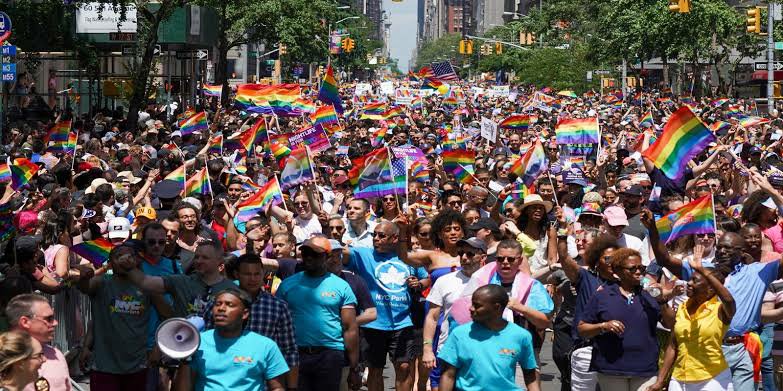
The point is that society will single me out as “that gay guy”, and so my sexual orientation informs the way that people perceive me, whether I want it to, or not. That affects me, because the way that people generally perceive gay men like me is rather negative. It leads to discrimination and alienation in most cases.
My attempt to branch out of the position of being discriminated against, and alienated, brings my sexual orientation into the forefront. I’m discriminated against, and alienated, because I am gay. Therefore, my only solution is to affirm my sexuality while rejecting the discrimination and alienation. Either way, my identity as a gay man is in the eye of the storm.
That’s basically what we mean by identity politics – you hold an identity, society has a particular reaction to that identity, and your way of living in the world acts as either an affirmation or a rejection of the societal narrative.
But identity politics is often used as a pejorative, in modern discourse. This is because the definition of identity politics has been distorted.
According to certain people, only certain groups are capable of playing identity politics while others cannot. In this story, black people, women, members of the LGBTQ+ community, immigrants, people living with disabilities – all of those people are capable of engaging in identity politics. But everybody else never seems to engage in identity politics, strangely enough.
Weird, right?
It is almost as if there is an implicit understanding that marginalisation breeds contempt, and that if you’re not as marginalised, then you are free from those feelings of contempt. After all, you are the machine. There’s nothing to rage against.
The part where it gets dangerous is the reason that the anti-identity politics camp gives for the contempt of the marginalised. For them, the anger of marginalised people is not only misplaced, but it should not exist at all. Because our laws (apparently) don’t make room for overt discrimination as in the olden days. Because most people are (apparently) not bigoted like they were in the olden days.
For this reason, any person who is politically influenced by their identity is seen as “playing the victim” and using historical oppression to invoke pity towards themselves rather than work hard like everybody else. That’s why identity politics, as a concept, is often sneered at. And it doesn’t take a rocket scientist to figure out which group of people are more likely to come to those conclusions.

The official opposition in South Africa, the Democratic Alliance (DA), has used the latter definition of identity politics as a rallying point. For them, South Africans are continuously taken in by the identity politics and populism of the African National Congress (ANC) and the Economic Freedom Fighters (EFF). But, they argue, the DA is the only party that does not play identity politics, or uses populist language, for their own gain. Instead, they are committed to service delivery, and improving the lives of all South Africans.
It’s a funny argument. Not because it is particularly new (this mentality has always underscored the DA’s election campaigns), but because of the issues that the DA has pledged support for.
Farm murders. All-white matric dances. The removal of race as a factor in determining disadvantage.
All of these – and more – appeal to people who tend to hold a specific identity. That identity is that of being a white South African.
It is no secret that the DA lost a lot of white voters in the 2019 national elections. Most of their lost voters defected to the Freedom Front Plus (FF+), an Afrikaner nationalist party.

This was a major factor in the DA declining in their share of the national vote – their first decline since the advent of democratic South Africa.
Their response?
Compile a report that, for all intents and purposes, called for then-leader Mmusi Maimane’s head. When Maimane was successfully ousted, the party engine all but orchestrated John Steenhuisen to be the next in line. Not even a strong campaign by a member of the KwaZulu-Natal provincial legislature, Mbali Ntuli, could rewrite what was inevitable.
And indeed, as I write this, John Steenhuisen is the leader of the DA.

This is the guy that the DA picked as their leader.
And he’s leading the DA towards a very interesting path – the path used by the Republican party in the United States. Mobilize a hyper-specific base around a hyper-specific message that subtly stokes racial tensions, and then gaslight anyone who sees the charade for what it is.
If you were to go to Steenhuisen right now and ask him who the current messaging of the DA is meant to appeal to, he would most probably say that it is meant to appeal to all South Africans. That is a lie. It isn’t.
The DA is attempting to appeal to their lost white voters who defected to the FF+ last year. Simple as that.
And that’s well within the rights of the party. If the DA is content with its current role and has no intentions of being the ruling party, then that is fine. Disappointing, but fine.
The issue that I – and many others – have with this approach is that when they are punished at the polls by everyone outside their base, the party is quick to pretend that this result is not of their own making. Instead, they blame identity politics. In their logic, it is the ANC and the EFF exploiting historical injustices and fooling the gullible electorate into believing in structural racism – for them, that is what leads to people not voting DA, the party that does not engage in identity politics.
There are so many things wrong with that view that dissecting it would take years off my life. The condescension, the grandstanding, the lack of self-awareness, the epistemic ignorance.. all of these are present in that view.
But my main focus is on the implication that the DA does not engage in identity politics. As I mentioned before, the DA is appealing to white South Africans who are DA voters ordinarily, but who were so turned off by “One South Africa for All” that they voted FF+.
And their appeal is predicated on something quite sinister. It is predicated on the belief that white South Africans are an oppressed minority.
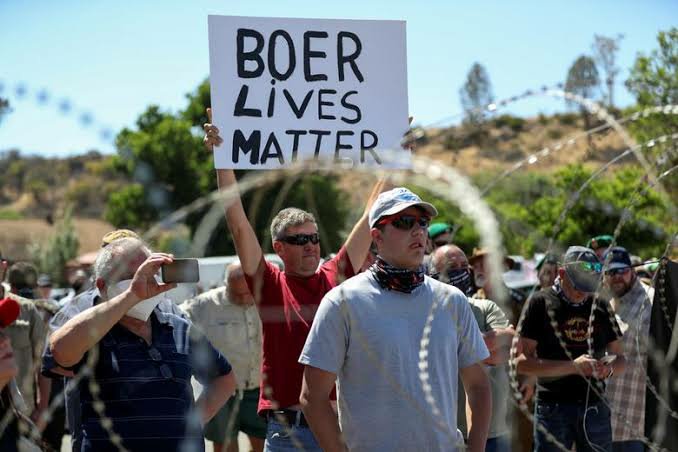
The portrayal of farm murders as an issue of national importance was done within the context of “white genocide”, the idea that there is a concerted effort by the South African government to kill all white South Africans. This “swart gevaar” (fear of black people’s supposedly violent nature) was at the root of galvanizing white South Africans towards the policy of apartheid.
Think about it – an idea that was formed from the spore of apartheid is one of the main hills that the official opposition in South Africa will die on, in the year 2020.
Far smarter people than I have dissected the actual statistics regarding farm murders, so I will not get into it here.
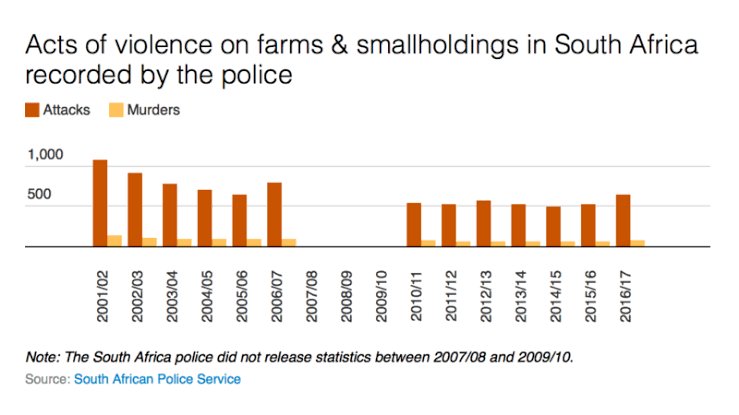
The DA is aware of all of this. The party is well aware of the controversy surrounding farm murders. Yet despite the controversy – likely, because of the controversy – they continue to wade right in.
Why is that?
It is because they are selling themselves as the cure to white people’s ailments. But for the DA to be the cure, there must first be an ailment. And they are constructing the ailment – white fear over their place in South Africa going forward.
There are a lot of reasons why white South Africans would be justifiably upset and disillusioned over the fate of the country. The fear of being systematically exterminated by “these blacks” is not a true, nor compelling, reason. In fact, the worry that white people have is the same worry that South Africans of all races have.
We live in a country with high levels of poverty, unemployment and inequality, all of which are exacerbated by the rampant corruption by the ANC government. And because of the conditions that most black South Africans live under, they are under the most threat of dying of hunger or falling into a pit latrine at a school with no proper sanitation.
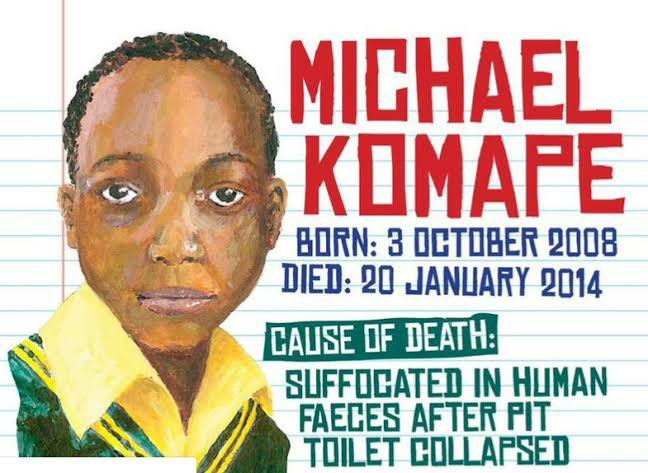
Choosing to look past the poor and disenfranchised in your country, only to later paint them as possible perpetrators of violence against a relatively better-off community is peak white identity politics. It is selling a narrative of fear and imminent danger towards a group, in order to get them to give you their vote because you supposedly have all the solutions to their problems. Problems you yourself constructed through misinterpretations and leaps in logic that defy gravity itself.
And it is THAT party that professes to be free of identity politics?
The DA identifies an identity (subtly, but expertly). They identify a specific reaction to that identity (“white people are under threat!”). The party then stands tall as the organization that will protect the dignity of that identity.
That’s identity politics, to the letter.
And as per their logic, they’re weaponising victimhood. After all, doesn’t the Constitution explicitly advocate for non-racialism?
Whichever way you look at it, the DA does not look good, upon deep reflection.
To be fair, they are hardly the only party employing identity politics. The ANC has settled on its brand as the liberation movement that ended apartheid, and gave us the great statesman Nelson Mandela, to prop itself up as the only party that has black South Africans’ best interests at heart. This is even as corruption is a more central part of the party’s DNA than Madiba.
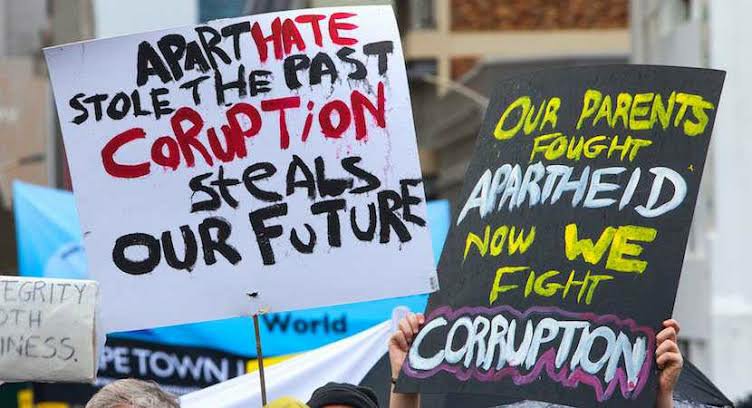
The EFF, on the other hand, has not been shy about targeting poor and working-class black South Africans – and wearing red overalls and domestic worker uniforms in Parliament. This is meant to signal solidarity: that unlike the ANC, they are there to distribute the country’s wealth amongst the people they feel deserve it most. Which is a curious stance, seeing as they can’t even distribute the spotlight within the party without facing the wrath of Julius Malema.
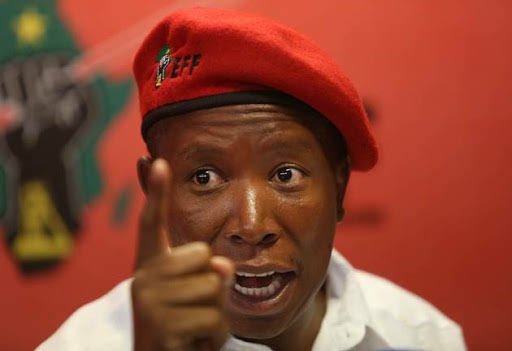
Those are the ANC and the EFF’s identity politics, which are both essentially promises to liberate black people. In that sense – and maybe, that sense alone – the DA is right.
But what they are wrong about is the idea that they do not engage in identity politics. That is a lie. The DA engages in white identity politics, or what is known as Trumpism – the politics of gaslighting and obfuscation, the politics of using victimhood as a key political strategy while accusing others of doing the same thing.
That is the DA’s identity politics, and they should own it. Until, or unless, they change their political stance, that’s their brand, for better or for worse.
But the DA can take comfort in knowing that this is not only a phenomenon that exists within the top 3 political parties.
Every political party around the world tries to galvanize people around a shared identity. More often than not, this shared identity will be portrayed as not having enough societal recognition. Because of this, the party concerned must get power in order to represent the identity group’s needs at the highest level.
Sometimes, this portrayal will be based on fact. Sometimes, it will be based on pure fiction. But one fact that few people can reasonably deny is that identity politics is all politics.
Hopefully, next time he makes a speech, John Steenhuisen will admit to this – and be the first political leader in South Africa to admit to his usage of identity politics.
I know. I know. It will never happen.
But in politics (as in life), we have nothing, if we don’t have hope, that one day we will have such a thing as an honest politician.
 wiseMusings
Leave a comment