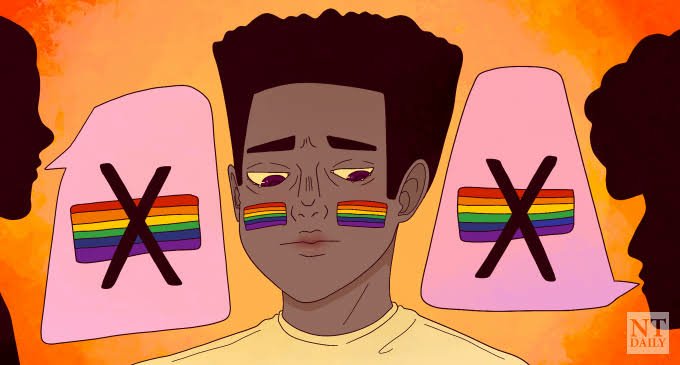
What is queerphobia? Most importantly, what does it do?
These questions came to me in light of an interesting week on social media, with two incidents involving the LGBTQ+ (or “queer”, which is used as an umbrella term) community.
In the first instance, a podcaster and his co-hosts made very disparaging comments about transgender women. The podcaster subsequently lost sponsorship deals due to an outcry by the queer community. This sparked comments (by heterosexual people) that the punishment was too severe, and that the revoking of the sponsorships was an attempt to sabotage a black man.
This was an attempt to shift the narrative. From a transphobic man who was dealing with the consequences of his actions, he was now a black man being dealt a heavy hand by the racist system that does not want to see us win.
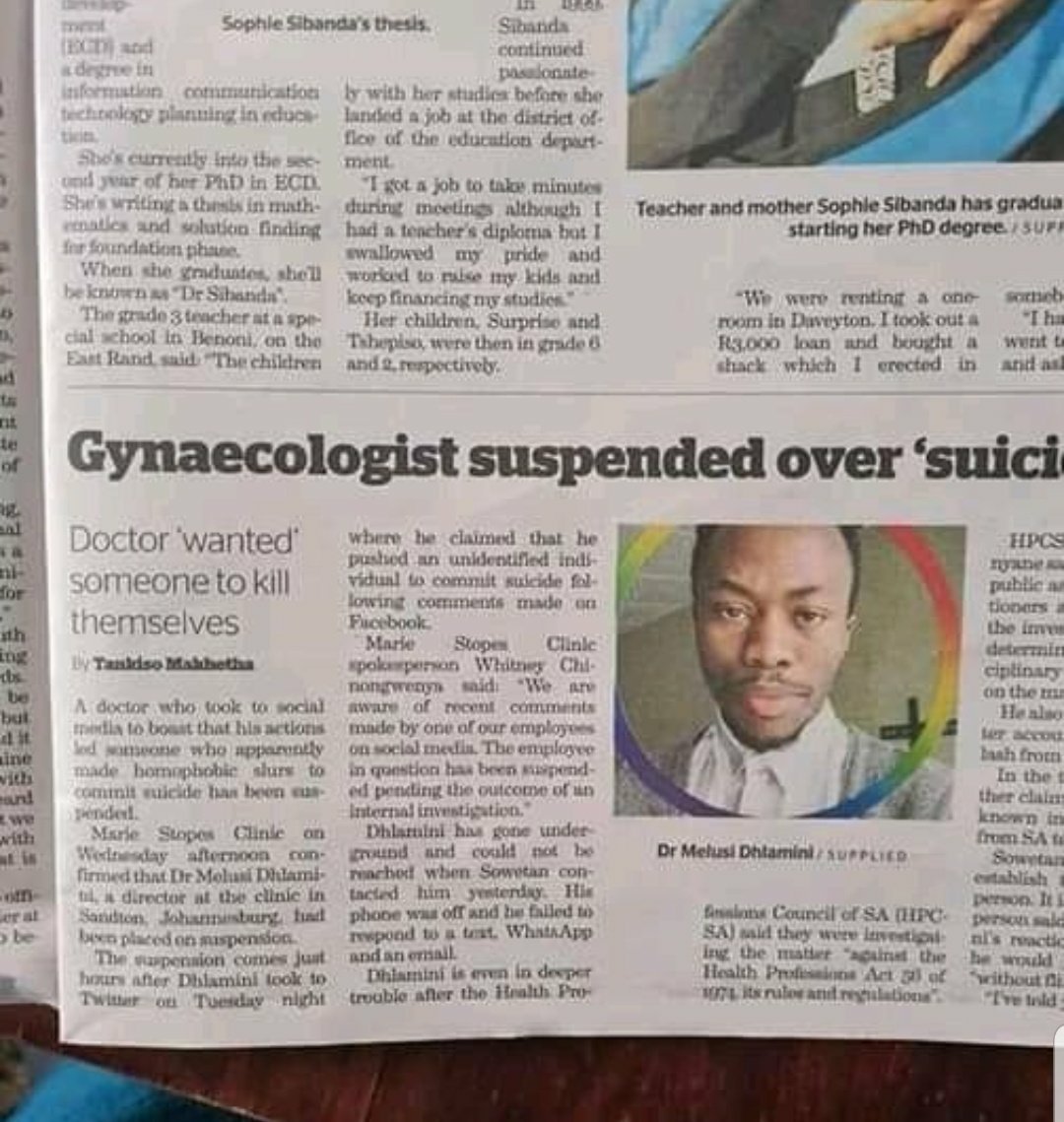
The second incident trails directly from the first. While heterosexual people claimed that the LGBTQ+ community is too “sensitive”, a doctor (who himself is queer) tweeted that he drove a homophobic person to suicide. While we did not get the full story, we could deduce that the person posted something homophobic on Facebook, the doctor reported him to his university, and that led to the homophobe’s expulsion and inability to enter any other university. The homophobe would then commit suicide.
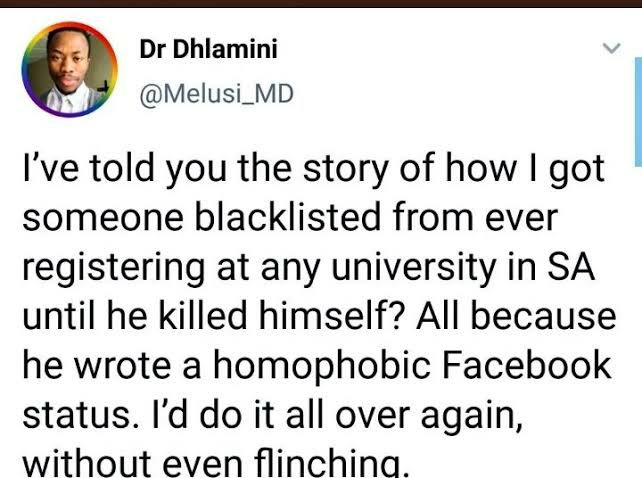
The response to this tweet was largely negative (from both heterosexual and queer people). The doctor was suspended from his job pending an investigation.
So there we have it – two cases. Two people who, from out of nowhere, began insulting the LGBTQ+ community. Then, when the LGBTQ+ community retaliated, the focus was placed on them for being too “sensitive” and too “harsh.” It is a classic tale in South Africa.
These two scenarios illustrate one thing – South Africa is still a very homophobic country. The passing of the Civil Unions Act of 2006 affirmed queer people’s right to get married. Before that, the Bill of Rights prohibited discrimination based on sexual orientation. So legally, we are one of the most queer-friendly countries in the world.

This is a big talking point for homophobes, who feel that the law has protected queer people enough, so what’s the constant fuss about homophobia? In their view, we’re not like most countries in Africa. We’re not Brazil. So we should be free to disparage queer people, because at least, we’re not murdering them en masse.
This ignores the fact that the law is only one instrument that is used to create a non-homophobic society. As great as it is, the law cannot regulate social attitudes on the ground. The law says that I am allowed to show affection to my partner, that I can have consensual sex with them, and that I can marry them. This is good.
But it cannot control people’s responses to our affection-showing, to our sex, and to our civil union. At best, the police can step in when there is an explicit threat to our lives, by way of physical violence.
Physical violence isn’t the only way that queer people’s lives are threatened, though. Every single institution in society holds some measure of queerphobia. Whether it is the home, school, the workplace, or government itself, there is both interpersonal and systematic exclusion of queer people.
When gay men are not killed with their penises stuffed in their mouths, lesbian women are punitively raped and killed.
When churches are not preaching verses that target and humiliate queer folk, Home Affairs officials (until recently) are making sure queer people’s right to enter into civil unions is incredibly difficult.
When teachers are not taunting queer learners for their sexual orientation, parents are chasing their queer children out onto the streets.
When queer teenagers are not lured in by older men to enter into sexual relationships (because the older man gives the queer person positive attention that the rest of the world doesn’t), queer people are raped by trusted family members.
This country is no haven for queer people.
Instead, it attempts to dehumanize them in the name of heteronormativity (the belief that only heterosexual people are “normal”). And that is what queerphobia is – a system that individually and systematically dehumanizes queer people.
That dehumanization may be unlawful, such as a company refusing to hire me simply because of my sexual orientation. That dehumanization can also fall within legal parameters, but still count as queerphobia – the insults, the jeers, the cold stares when queer people commit the mortal sin of holding hands in public. That’s all queerphobia, folks.
And the reason why we are quick to recognise the evil in a Vicky Momberg racist-fuelled tirade, but see nothing wrong with that podcast and the crass terms it used to describe transgender women is sadly simple to decipher. It’s the normalization of bigotry.
To be honest, we don’t see those comments as being problematic at all. That’s because we have internalised the idea that cisgender people – people whose biological sex matches with their gender – are “normal” (remember heteronormativity?) and that everybody else is a walking factory fault.
Therefore, when someone says something transphobic and faces consequences for that, we’re more likely to chalk it down to a “muzzling of his free speech” rather than a bigot being punished for bigotry. Instead of seeing trans women as people who had their personhood relegated into a joke, we choose to render them invisible. We choose to see the people who said those awful things as “victims”.
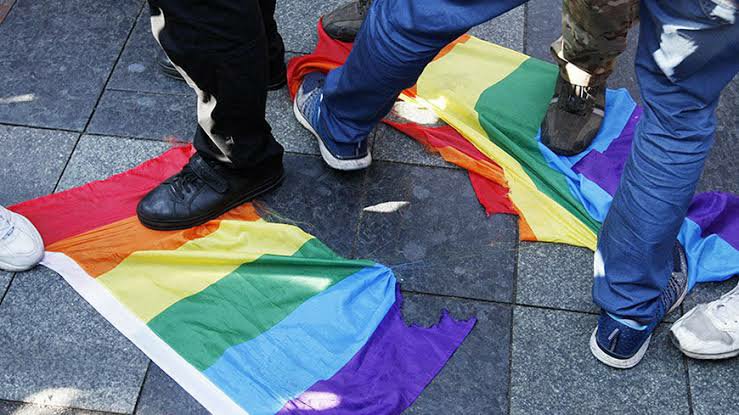
Because for us, there is no “other side of the story.” For us as a society, the transgender community (and the entire queer community) are a group of deviants who want to justify their deviance. That is the extent of our queerphobia – we don’t want to know the struggles of queer people. Out of sight, out of mind.
That’s because we know that a single look, a single glance, a single peek could disconfirm what we have been socially conditioned to know about the world. We feel threatened by queer people. Not because they’ll “turn us into gays” or whatever.
It is because if we were to fully accept queer folks as human – going beyond the “what they do in bed is none of my business” centrism – then we would have to accept that all these institutions were actually distorting the truth, at best, or lying, at worst. And we can’t have that.
So we launch a full-frontal attack on a group with even less social standing than we do. Because instead of dismantling the essence of colonialism and apartheid – the dehumanization of one group in order to set the other group as the standard for all of humankind – we have merely replicated the model, and used it for our benefit.
And that’s what queerphobia does – it props cisgender and heterosexual people up as “normal”. The standard. The ideal. And if you do not fit within those two categories, then you don’t matter.
This was made clear to me from the doctor’s tweet. He saw a homophobic post (which, as others say, was inciting individuals to beat up queer people on his campus) and he reported it to the authorities. Looking through that lens, he was defending himself and other queer folk.
The fact that this led to a downward spiral for the homophobe couldn’t have been known at the time. And even if there was a crystal ball that predicted the future, the doctor was justified in reporting the post.
And anyone who argues otherwise is saying that the life of a homophobe who deliberately expressed a plot to enact violence on queer people is more important than queer people’s right not to be viciously attacked because they’re queer. And if you’re arguing this, then you’re wrong.
The only crime that the doctor is guilty of is hubris. He did not drive the homophobe to suicide. The homophobe’s homophobia is what led him to suicide. Remove that, and all that comes after does not materialize.
But social media – and regrettably, the press – are highly indebted to heteronormativity. So the doctor was the person put in the metaphorical dock for defending himself against violence, and for expressing joy that his would-be violator is dead.
Wild.
Especially wild, because when a bigot passed away not too long ago (that bigot being Penny Sparrow), there was no sadness at all from the majority of black people.
The difference is dehumanization. The doctor, and those who are like him, are not seen as human. Their job is presumably to protect and serve the interests of heteronormativity, even when it works against them. In addition to that, queer folks must never express joy when a homophobe dies, even when that homophobe had plans to torment them.
Instead, they must be Mandela-like in their capacity for forgiveness and generosity. They must accept their fate as sub-human and they must be superhuman. But no matter what, they can never be human.
That is exactly what the critique of Nelson Mandela’s ideology of non-racialism is. But we can’t recognise when the same unrealistic standards are asked of queer people.
Because of this, we fail to realise that queerphobia does the same thing that racism does. That sexism does. That xenophobia does. That classism does. That ableism does. That every single system of discrimination has ever done: it dehumanizes the uncommon group in order to make gods out of the common group.
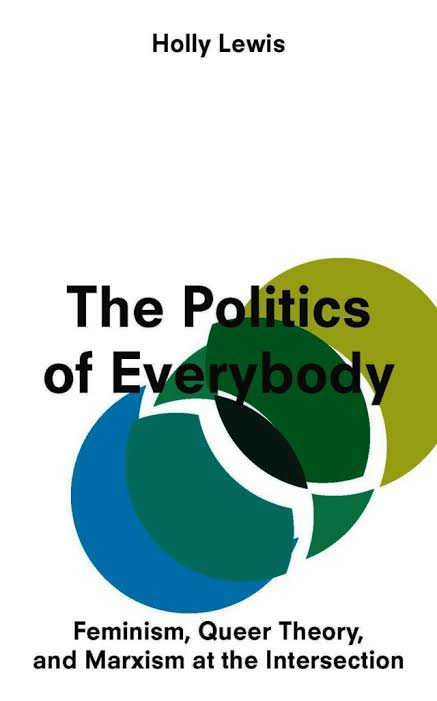
Which is why the “politics of everybody”, as espoused by author Holly Lewis, is so important. If we always begin from the premise that everybody deserves to have their humanity affirmed (not simply tolerated, but affirmed), then we will be better equipped to spot instances where one group of people has their humanity questioned, and rally against that mode of thought.
Funnily enough, liberation for queer people – socially, economically and culturally, just to name three – will liberate even the diehard heterosexuals among us.
They’ll be liberated from the idea that their humanity only matters if another group’s humanity does not. They’ll be liberated from ideas that have their origins in bygone eras, and are of no use in the year 2021.
They’ll be liberated. And so will we.
 wiseMusings
Leave a comment