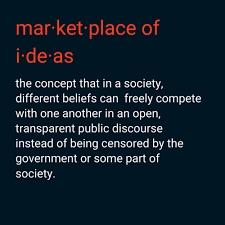
How many marketplaces of ideas does it take to create a just society?
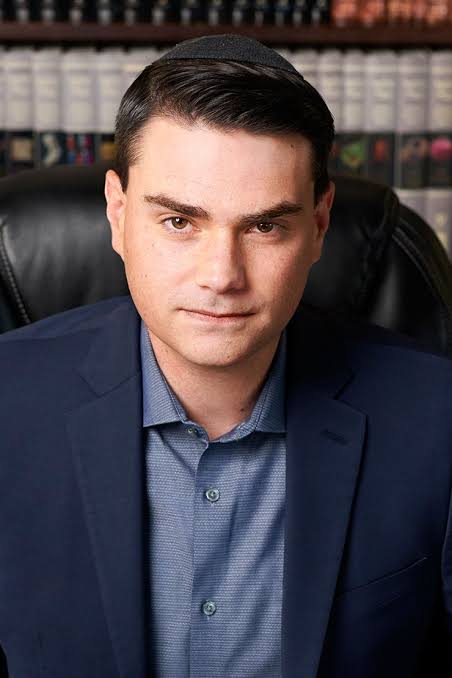
I’ll argue – none. Because the Marketplace of Ideas is inherently unjust, no matter how inclusive we try to make it. That isn’t for a lack of good intentions. I’m sure that at least some people who believe in unfettered free speech come from a good place: they believe that freedom of expression is a central right, and when we regulate it in any way, we obstruct people’s liberty, and are thereby being authoritarian.
I must say that as mean as my scowl looks, I’m not one to deny people their liberties. I want you to be free, and you to be free. I want everyone to be free!

And that’s the point of it all – I want everyone to be free. Not only to express themselves, but to live lives filled with dignity, and wherein they feel like they have a stake in the wellbeing of our society. To be honest, unregulated free speech doesn’t achieve that for some people.
In the words of a podcast I really really like, “let me paint you a word picture.” Imagine two podiums, several metres apart. On the right podium, there stands a conventionally attractive woman. Red lipstick, hourglass figure, high heels. She’s wearing spectacles, and has a speech in hand, ready to deliver. She’s flanked by a swarm of camera-carrying journalists, waiting with bated breath to capture every single word of her speech. She soaks in the adulation, well aware that the front page of tomorrow’s newspaper will have her name (and most importantly, her perspective) on it. Summoning her power, she reads out the title of her speech: “Why Homosexuals Should Not Have Rights.”

On the left podium, there stands a man wearing a suit and tie. He is an academic from a prestigious university, but whose position allows him to wear more casual clothing. However, this is a formal debate. Therefore, he (reluctantly) is highly encouraged to wear a suit. He is uncomfortable. Because of this, he is a tad bit irritable. There is one journalist from a gay news organization who’s ready to record the musings of this man, who brought a file filled with stats and quotes from pioneers of the LGBTQIA+ community. His first few words, when the attention turns towards him? “Are you aware of how many lives you’re putting at risk with those words?” Some journalists from the right podium openly roll their eyes. One whispers to the other, “emotions. Feelings. How typical.”

And between the two podiums, there is a crowd. Not a big one, maybe 80 to 100 people. Some of them are queer. Some of them are homophobic conservatives. But a good number of them don’t know how to feel about “the gay lifestyle.” They are fine with everyone living as they choose. They don’t care what happens in the bedrooms of other people. But, faced with this “homosexual craze” that is now “being taught to children”, they have to know more. They have to hear both sides of the story. And while the left appears antsy and overemotional, the right appears confident and charismatic.
It will also be no surprise that for those who couldn’t attend the debate, the vast majority of tomorrow’s newspapers will, indeed, have the Lady on the Right as the cover story. They will portray her as “well-spoken”, “self-assured”, “seemingly rational” and “the star of the show.” The op-eds will be more blunt, saying that homosexuality is indeed a sin that shouldn’t be allowed to grow its roots in society, because it produces child molesters and sexual deviants.
The Man on the Left will be given far less coverage. The troll of the day (let’s call them Sen Bhapiro) will tweet a rather unflattering picture of the Man on the Left shouting in frustration, and caption it with something about facts, feelings, and one not caring about the other.
That, my dear friend, is the Marketplace of Ideas.
Let’s examine the analogy: a marketplace is a central point wherein goods are bought and sold. This is already emblematic of one thing: if you’re poor, you’re probably not going to be here. As a result, your idea isn’t going to be here. It can’t be sold, therefore it’s useless. How inclusive is that?
Secondly, an idea is “a thought or suggestion as to a possible course of action”. At least, that’s what the dictionary said. This implies that an idea isn’t just some discrete, peripheral unit that is detached from our reality. In many ways, ideas are the starting points of our reality. You have an idea to bake a cake. That leads you to a specific course of action: going to the shop and buying ingredients for baking a cake. You have an idea to be more fit and to lose weight. That leads you to a specific course of action: taking up your tennis racket and your tennis ball from where you last left them a decade ago, and playing 5 times a week.

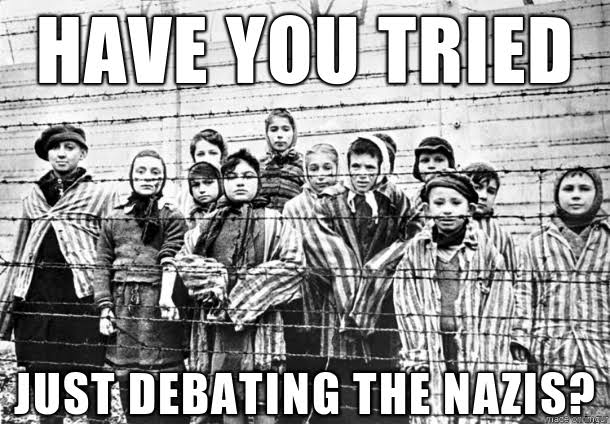
In this sense, ideas can be good. But there’s also been an instance where someone had an idea to rid the world of Jewish people. That led to a gruesome course of action: the Holocaust. Some people once had an idea to get labour for their farms. This led them to a horrific course of action: buying and selling other human beings, and exposing them to inhumane working conditions for absolutely no pay.
These are all ideas. And the Marketplace of Ideas, by its very nature, stipulates that we should give ideas of this nature room to breathe. Not because we necessarily believe in those ideas, but because we have counterarguments that will show the absurdity of these ideas. If slavery is so wrong, then surely we’ll be able to capture the hearts and minds of slave owners? If homophobia is so wrong, then surely we’ll be able to capture the hearts and minds of homophobes? If we can’t, then our ideas must not be very good. If we can’t package our ideas well enough, if we can’t spoonfeed our ideas to people and get them to swallow and digest them, then we have failed.
Guess it’s back to slavery, then.
That’s a fundamental part of why the Marketplace of Ideas thesis leaves me skeptical: it commodifies ideas, so much so that even bad ideas can win the debate if they have enough backing behind them. And as I’ve mentioned, marketplaces aren’t made for everyone. Money, and not necessarily the soundness of an argument, wins the argument. If I’m a billionaire with an interest in convincing people of Y rather than X, then I can simply acquire an existing media company, or create a consortium of media companies, where they all funnel slight variations of my worldview through print media, television, and the internet.
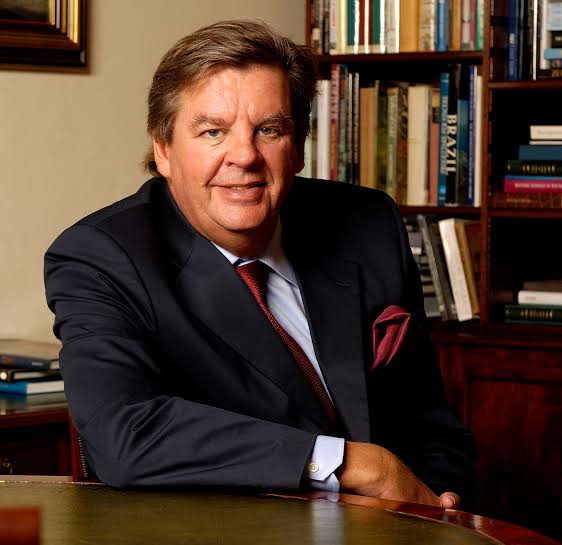
That’s how markets work – one needs capital, and one needs advertising. And if we have a marketplace that is devoted to the buying and selling of ideas, then the same rules will apply there. Morality is chucked out the window in favour of “winning hearts and minds”.
And that’s how we get to my biggest gripe with the Marketplace of Ideas – even bigger than all the issues I have listed above.
The biggest problem I have with the so-called Marketplace of Ideas thesis is that it believes that the truth will prevail.
It is optimistic about the process of individuals within a society making free, rational, objective decisions about issues once they are presented with all the facts. I’m not as optimistic.
And this might read as a “people dumb, me smart” argument, but it’s really not. I’m just as susceptible to confirmation bias as anybody else out there. It’s because of the acknowledgement of my own susceptibility that I’m pessimistic.
If the way to create a better world was just a few debates away, then members of the LGBTQIA+ community would not be fighting an uphill battle in most parts of the world just to be able to have sex without potentially being arrested. There would be no such thing as racism or sexism. We’d probably make better personal decisions. The environment would probably be taken care of, a whole lot better. But it is not the case, and not for a lack of information.
And someone might object by using Barack Obama’s favourite quote: “the arc of the moral universe is long, but it bends towards justice”. Or in other words, the truth might not be acted upon now, but if we plant the seeds for it to be undeniable, then in good time, it will survive while the bad ideas will recede into the dustbins of history. So the truth does prevail, but sometimes it takes time.
I think there’s a lot of hindsight bias associated with that view. It presupposes that things would’ve always turned out this way; that an era of rights and multiculturalism and globalization was inevitable. It presupposes that apartheid was always going to fall. It presupposes that LGBTQIA+ rights were always going to be acknowledged as a public good. It presupposes that the feminist movement, in all its waves, were always going to meet their objectives.
And there’s a lot of revisionist history there. It ignores the political battles that were fought in order for all those things to come into fruition. It erases the agency of all of those people who were shut down by the “Truth of the Day”, but who decided to go against it anyway. It looks at the neoliberalist tendency to package things into cute little nichès, and calls that “progress that was bound to happen”, because it feels so natural to us now.
I believe that the acknowledgement of LGBTQIA+ rights is a good thing. I’m happy that I live in an era (and a country) where I can be openly gay, without any legal repercussions. But I know that this era (and this country’s protection of queer rights) was not set in stone. It was not always like this. It took political activism, it took a lot of negotiations and deliberations.. and it took a lot of convincing.
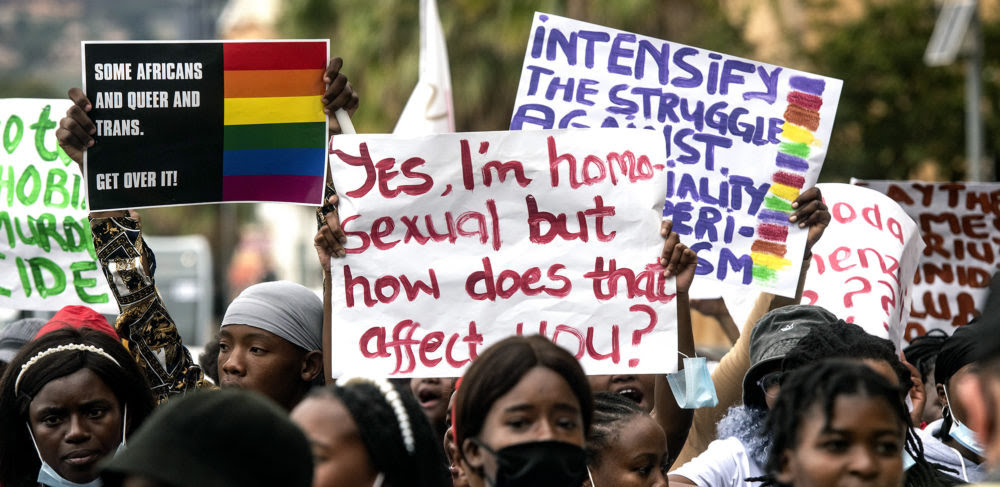
“Voila!”, someone might say. “There is evidence of people discussing their way into a better social position. So how, exactly, does the thesis not hold?”
It doesn’t hold, dear objector, because it was politically expedient for the “gay rights” discussion to even be brought to the table. That is the only reason S.A has a progressive (legal) stance regarding queer rights than most countries in Africa. Nothing more, nothing less.
If we listened to the folk who wanted us to “win the hearts and minds of the majority” when the Civil Unions Act was enacted, can we honestly say that in 2021 (fifteen years after the fact), South Africa is any closer to being a country that believes that gay people are actual people?
The stats regarding the brutal murders of gay people in 2021, alone, has your answer.
And that brings me to finally discuss what the truth actually is – it’s a political value. It is shaped and defined by the political moment we find ourselves in. The truth doesn’t win out, because it’s true. The truth wins out, because the right people have bought into it as the truth – and so, truth it shall be.
Do debates and deliberations help us in getting our “truth” to be considered? Yep.
But strikes, shutdowns and civil disobedience also does the trick as well. Getting an idea such as “the majority of South Africans deserve to vote for the political party of their choice” to be accepted as a truth took decades. And you can decide how good or bad that claim is.
My point is that “public reason” is a philosophical fantasy we ought not to buy into, if we want to participate in actual political conversations. That is surprising, coming from a philosophy student. However, philosophy has its limits. As a prospective political and legal philosopher who has practical political experience, I’m well aware of this. That’s not to say that philosophy has no use in answering questions of political importance. What I am saying is that we should be careful not to prioritize the world as we want it to be, and forget the world as it currently is.
Political philosophers generally start and end from their ideal. They argue for how society should organize itself. The End. What is much more difficult (but luckily, what I’m seeing more of nowadays) is grappling with the non-ideal, in all its paradoxes and contradictions. Start with the messiness. And maybe I’ve misunderstood the basic premise of what a political philosopher does. Maybe political philosophers need not think about reality. Perhaps, theorizing about a better world is the only requirement listed on the job description.
If that is indeed so, then political philosophy is less relevant to the world than it’s ever been. Furthermore, it’ll remain an enterprise only of those who can afford to build castles in the sky at work, then go home to their (comparatively) cozy middle-class lives. And that’s unfortunate.

But back to the truth – if you truly believe that the good folks always win because the truth is on their side, then walk over to someone who’s anti-welfare, and tell them the truth: “poor people deserve food, they deserve shelter, and they deserve to live a decent life. Social grants help them do this.” List stats if you’re a numbers person (I suck at numbers, so count me out). Then see what good that does for the community-at-large.
Alternatively, if you have any sense of history and how marginalised communities have gotten anything done in the history of ever, you will look at how the recent unrest in Kwazulu-Natal and Gauteng led to the reintroduction of the R350 grant to help unemployed South Africans survive.
As much as the very thought of the unrest still gives me anxiety, and as much as I hate the fact that the unrest happened, it was (at least partially) an opportunity for poor unemployed people to get food for themselves and their families, thereby sending a message to the South African government that “people are hungry, and they will break the law to eat.” Decisions were made in the wake of that disaster – and here we are.

How many petitions were signed since April 2021? How many discussions have occurred on public platforms about the reintroduction of the R350 grant? How much good did that do? And contrast those discussions with practical political action to see what methods won the battle.
Once again, political manoeuvring dictated the truth, that poor people deserve to eat. And the marketplaces were trashed and burnt to shreds, in service of that truth. If there’s any irony in the world, it’s that.
 wiseMusings
Leave a comment