Elon Musk bought Twitter.
Admit it – if you’d read that sentence a year ago, you’d think I was writing a script to a dystopian movie where the richest man in the world buys the most prominent social media network in the world to boast about how great he is.
Well, dystopia is our new reality – as with most unbelievable things that have happened in the world.
The chatter around Musk buying Twitter began with a tweet from the billionaire, wherein he wrote: “given that Twitter serves as the de facto public town square, failing to adhere to free speech fundamentally undermines democracy. What should be done?”
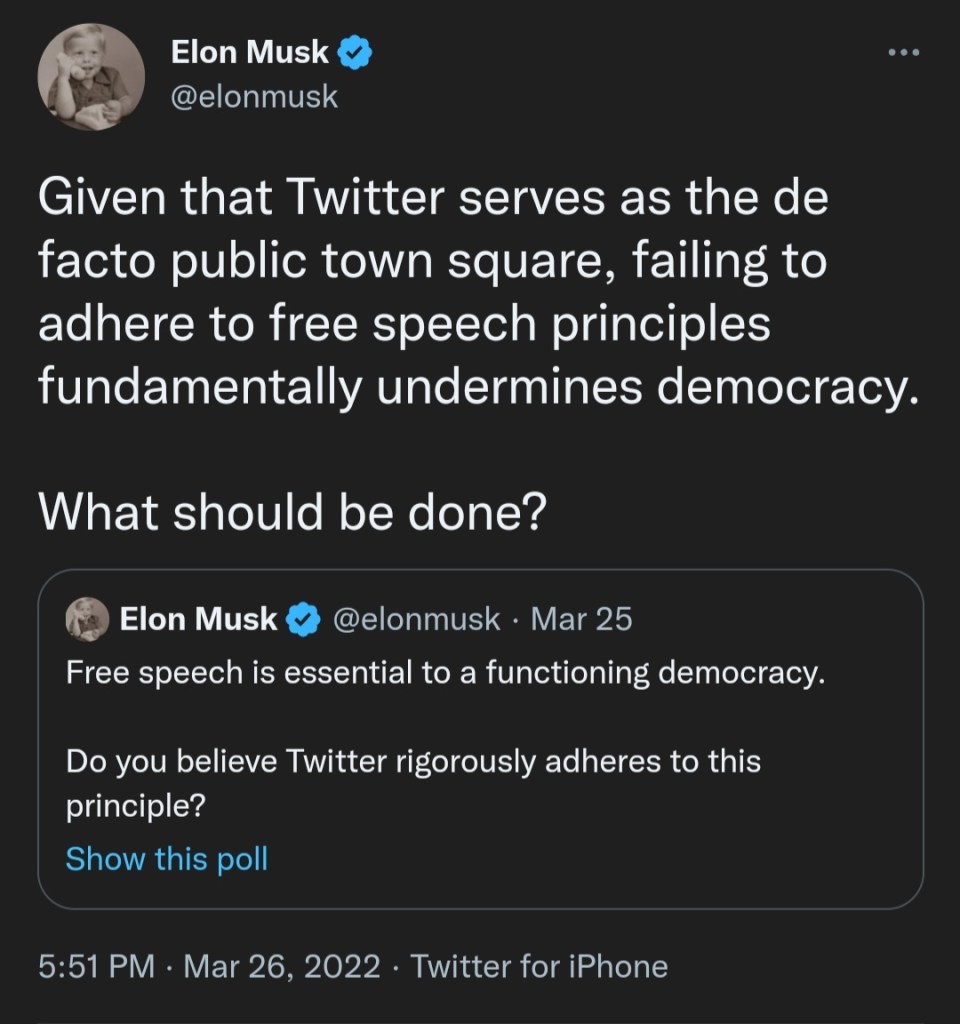
Buy Twitter, apparently.
But let’s look at the reasoning behind the Tesla owner’s decision to buy Twitter.
(1) For him, it’s a given that Twitter is the public town square.
(2) He seems to believe that democracy has been undermined.
(3) He believes that speech restrictions are what undermine democracy.
(4) The implication is that Mr. Musk wants to remove speech restrictions, and let people say exactly what they want at all times. This seems to be what he means by “free speech” – all or nothing, absolute, and insulated from any sanction.
He doubled down on this, by tweeting: “for Twitter to deserve public trust, it must be politically neutral, which effectively means upsetting the far right and the far left equally.”
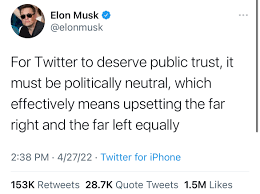
What does the father of X Æ A-12 Musk really mean by this statement?
(5) He believes Twitter isn’t trusted by the public.
(6) The lack of public trust, Musk believes, is because Twitter isn’t politically neutral.
(7) He believes that achieving political neutrality can be achieved by causing discomfort towards both members of the far right & members of the far left, whom he sees as two sides of the same coin, in all his centrist glory.
Now let’s see how well Elon Musk’s thoughts about free speech hold up to a little scrutiny.
Twitter being the public town square is probably a correct assessment. But it might be correct for a specific subset of folks rather than an absolute assessment.
The United States (where Musk lives & where the cultural power of the world is stored due to imperialism of a special kind known as “soft power”) has about 330 million citizens. How many of them are on Twitter? 83 million of them.
That’s, what, 25% of the population?
Not to mention that most of those folks graduated from college (or what we call university).
The data tells us that less than half of the U.S population is on Twitter, and the folks that are tweeting? They’re mostly graduates from a very exclusionary higher education system.
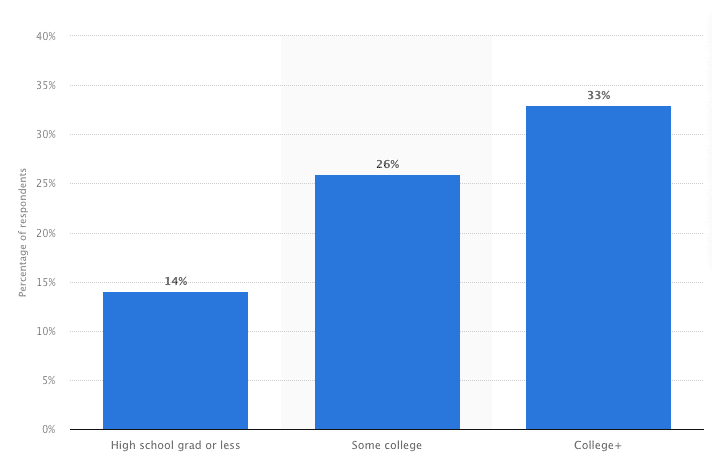
This isn’t a minor detail. It tells us a lot about who Elon Musk believes to be “the public”. Is his idea of “the public” merely a homogeneous group of folks who are more likely to be financially well-off by virtue of having a higher level of education than most folks & therefore, unaffected by most of the country’s burning issues?
If so, then how effective is Twitter at being the de facto public town square? If people are talking on Twitter, and no poor person is around to chip in, does it make a difference?
Then Musk goes on to blame the decline of liberal democracy on free speech limitations. Liberal democracy’s shortcomings have been amplified in the past decade or so. Some of those shortcomings have had to do with speech norms and how they apply to our social and political lives. I’ll give big Elon a cookie for good observation on that front.
Here’s the thing, though – in most countries (especially democratic countries), free speech limitations weren’t the problem. The problem was that people use free speech as a license to say some discriminatory, harmful things. In a society where one can say absolutely anything all of the time, best believe that you’ll see people blurt out slurs and epithets that threaten marginalised communities.
And guess what? That’s what was happening on Twitter. Despite the hate speech policies that Twitter has had in place, more than a few folks (all from marginalised communities) have encountered death threats, or received DMs with slurs directed at them. And so the big question regarding speech norms wasn’t “how can we revert to a period when free speech was absolute, and everybody could say what they want?”
The question was “how do we preserve the right to freedom of expression, while protecting marginalised groups from the harm embedded in hateful speech?”
The former question implies that people are muzzled, and that nobody can say anything critical anymore. The latter question is far more nuanced, because it acknowledges that freedom of expression is important, but not at the expense of living, breathing human beings.
This gets to Musk’s declaration that “free speech absolutism” – basically say whatever you want, at any time, anywhere – is the answer to all of our free speech problems.
Well, let’s see the rational and thoughtful analysis that Twitter users brought to the platform with their free speech absolutism:
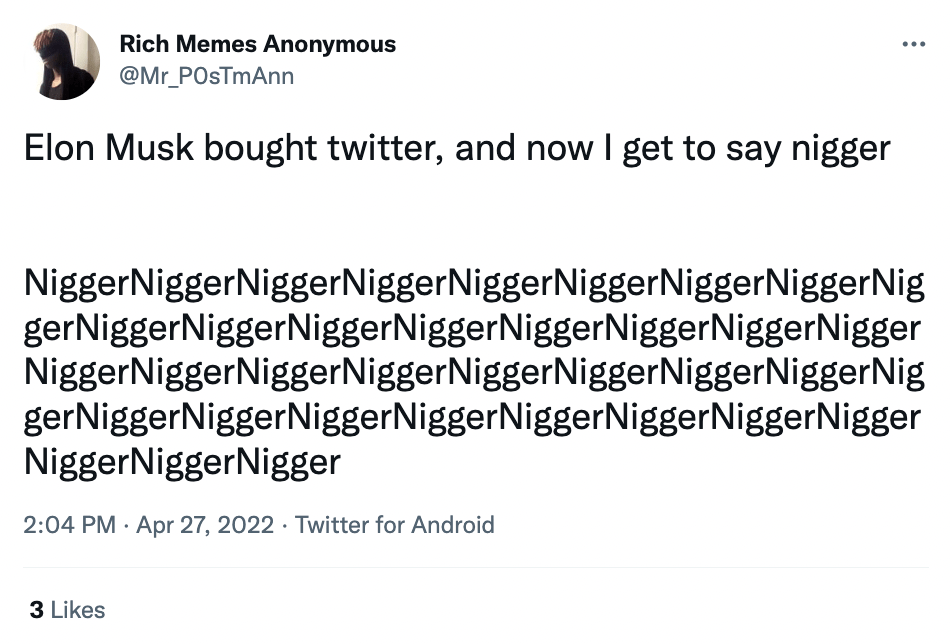
The point (if you didn’t catch my sarcasm) is that free speech absolutism is a problem. It’s a problem because for many folks, free speech absolutism just means the right to place a swastika flag outside their homes, and wear white gowns while calling every Black person a “nigger”.
It’s basically transgressing basic human decency in the name of being a contrarian 20-year-old piece of shit.
It would be bad enough if the contrarians, with their iconography and their slurs, were just being assholes in a vacuum. But we live in a society.
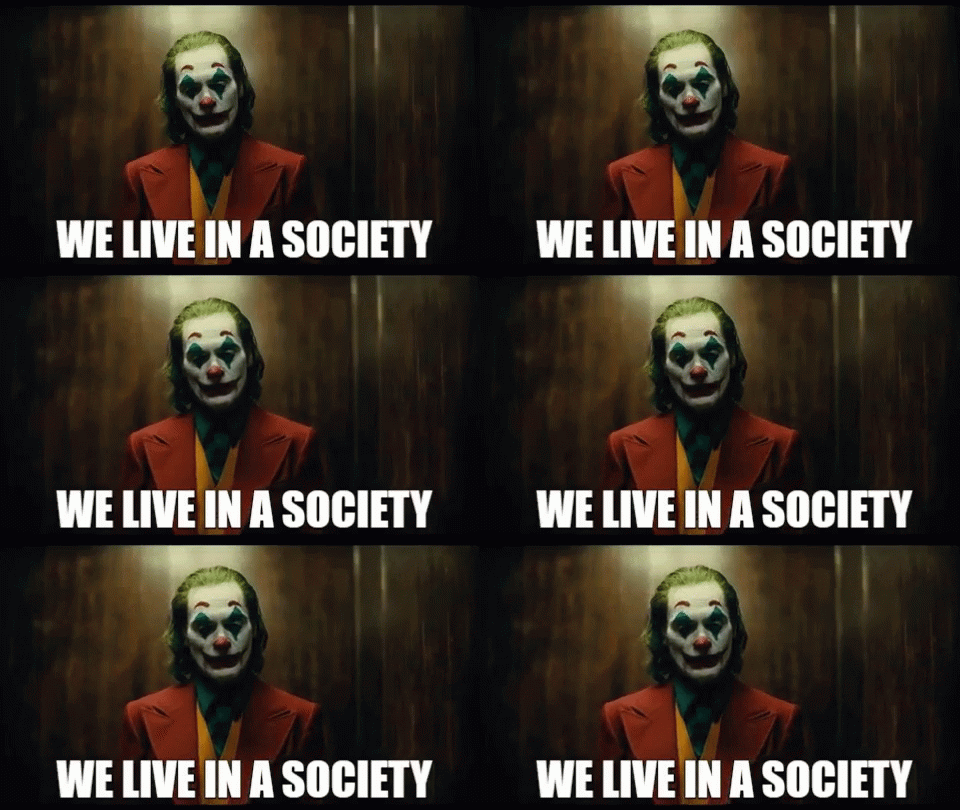
Jewish people see a swastika outside someone’s home, and they see a dangerous situation for them. Black people see a white person wearing a KKK gown, and hear the word “nigger” from a white person’s mouth, and they see a dangerous situation for them.
Words aren’t just words. Iconography isn’t just iconography.
These are mobilising tools, because they have historically been used to signal hatred for a particular group.
So if an anti-Semite sees that swastika, they’ll know they’ve got a friend in their neighbourhood. They know that their anti-Semitic views are accepted, and acceptable. Imagine if enough people have their bigoted beliefs affirmed? Imagine how emboldened an anti-Semite would feel, knowing that they’ve got a base of people on their side. Imagine how opportunistic politicians would ride the anti-Semitic wave, simply because this would be the best way to rally a political group together: get them to hate, and they will come.
Imagine what that kind of environment would feel like for Jewish people.
All of that starts with words. All of that starts with one flag outside somebody’s house, a somebody who knows that the First Amendment will insulate them from any adverse consequences.
That is why free speech absolutism is a problem.
What else is a problem? Elon Musk believing that Twitter has lost public trust because Twitter isn’t politically neutral.
And, of course, the solution to that problem is to give the blue checkmark used for expert verification to anybody who can shill out $8.
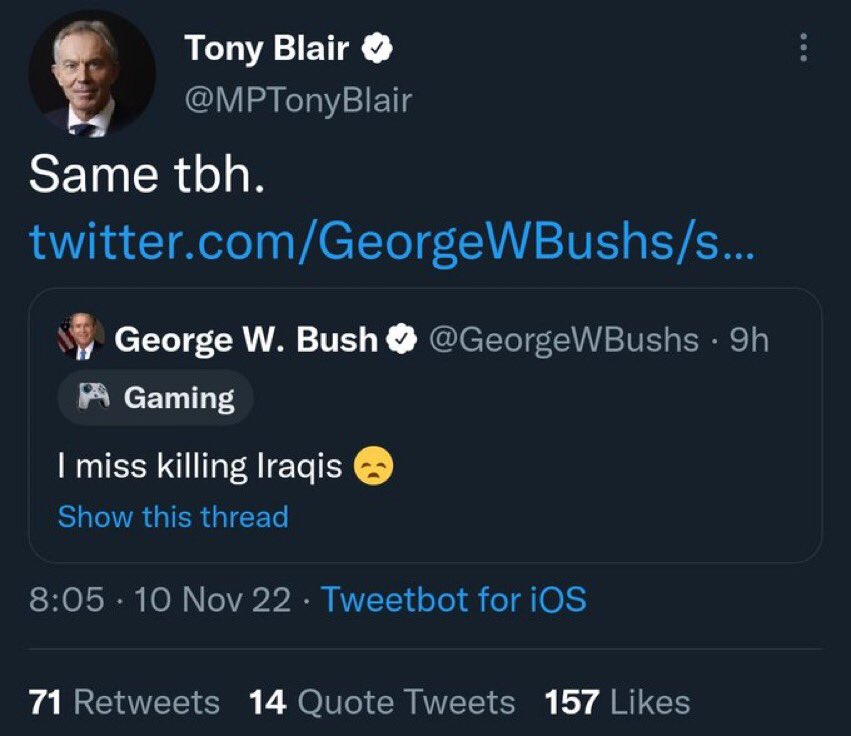
Elon, if you ever read this (and I’m sure he never will): the reason why Twitter had lost public trust was because of the disinformation and misinformation problems that are part and parcel of the social media experience.
Up until fairly recently, Twitter had a decent response to these problems – before sharing an article on the platform, you’d be asked if you want to read it first. There would be context given to certain Tweets that were false or misleading (Donald Trump even had his Twitter account deleted because of this). And there were blue checkmarks for public figures, so one could determine who the real person is, amidst a ton of parody and fan accounts that could pretend to be the person.
It wasn’t a perfect system. Misinformation, and more often, disinformation were still pretty prevalent. But there were checks and balances to offset the worst of it. Insofar as social media regulations go, “good enough to offset the worst of it” is a pretty high bar to reach, considering the sheer volume of Tweets that are written and sent each day.
Tragicomically, the “genius” known as Elon Musk decided to make the blue checkmark a status symbol, easily purchased, rather than understanding its true purpose as one of the bulwarks against disinformation.
Thanks to Elon Musk, Twitter is now less trustworthy because of his fundamental misunderstanding of what the blue checkmark actually represents. So much for his smarts!
Then we get to the meat of the matter – his belief that the far left and the far right are equally responsible for the polarised hell that is our current society.
“Both-sides” journalism has been on the upswing ever since Donald Trump assumed the U.S presidency. The idea behind “both-sides” journalism is the belief that Republicans (and/or Republican supporters) take up a good chunk of the American electorate, and therefore, their views should be given the same respect and acknowledgement as that of Democrats (and/or Democratic supporters).
On the face of it, that belief is plausible. It’d even be the correct view in a world with sense. “Both-sides” journalism, however, is the incorrect stance to take in the current social and political landscape.
When Republicans and their supporters distort basic facts, down to the point of outright lying, then they’re committing an assualt on truth. Truth – and by this, I mean the ability of human beings to agree on a set of facts – is crucial to a functioning democracy. A conservative person and I might have political and ideological differences. That is absolutely fine.
What isn’t fine is when my conservative counterpart starts talking about things that never happened, and expecting me to take her interpretation as the truth. Matt Walsh, transphobe of note, said that millions of children in the U.S were on puberty blockers. The real number of children in the U.S on puberty blockers? Less than 10 000.
Why should a person like Matt Walsh be given a national platform to pull data regarding transgender children out of his ass, just to further his vitriol? If Walsh’s data points were correct, then we could have an ideological debate (although we shouldn’t ever debate the existences of people, my point is that the possibility exists for that). But how do you debate with somebody who says that the earth is flat, and that the theory of a round planet is a conspiracy conjured up by “global elites” (a dogwhistle for Jewish people)?
It’s simple. You can’t.
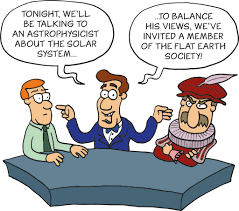
Their ideas are so ludicrous that you’d firstly have to give an entire seminar about astronomy, conspiracy theories, and the benefits of science in order to have a fruiful conversation. We are entitled to our own opinions. We, however, are not entitled to our own facts. But when opinions are given the same value as facts, in an attempt to be impartial, then we muddy public discourse and we imply that one can interpret facts in different ways (it must be noted that assaults on facts are not a rigorous critique of traditional epistemology).
“Both-sides” journalism takes bad-faith, ignorant, false and malicious claims, and puts them on the same level as facts. That’s what Elon Musk argues for: a platform where the most ridiculous falsehoods go head-to-head with facts, in a true “marketplace of ideas”.
I’ve mentioned in a previous article why that will never truly work, but long story short: far-right conservatives stall social progress by making us eat a plate of chicken shit everytime we discuss something that’ll bring about meaningful change. The more time we spend arguing about whether the ice caps are really melting, despite obvious scientific evidence to prove this, the less time we have to actually combating climate change.
That’s Elon Musk’s views, deconstructed. But does it even matter?
Elon Musk is an incredibly intelligent man. When it comes to engineering and technology, he might just be the best in the world at that. But here’s what Elon Musk (and everybody) should know:
EXPERTISE IN ONE AREA DOESN’T MEAN EXPERTISE IN ALL AREAS OF LIFE.
I’ll type it again:
EXPERTISE IN ONE AREA DOESN’T MEAN EXPERTISE IN ALL AREAS OF LIFE.
Elon Musk has an unrefined, layperson understanding of societal and political problems. Elon Musk thinks that his intelligence in the sciences gives him the necessary training to solve every social problem known to man. Pity that he isn’t aware of his own ignorance in this department (that which he has in droves).
People who take seriously the change in speech norms, and who sincerely grapple with these issues every day, don’t do so because they have nothing better to do. They do so because social problems are more multifaceted and complex than people give them credit for. Elon Musk isn’t the first person to have the opinions regarding free speech that he currently has. In fact, it’s a view so common in libertarian circles so as to be trite.
Elon Musk being a libertarian is okay. Elon Musk tinkering with tried-and-true Twitter processes in order to reinforce existing societal inequalities isn’t okay – at least not for Twitter the business. Even if he used a businessperson’s viewpoint to justify Twitter deregulating its hate speech policies, Musk would still be found wanting. No business in the 2020s wants to have their product or service advertised right before, or right after, someone has called a Black South African a kaffir. There are real financial consequences that the Tesla CEO might suffer – and there probably won’t be enough $8 subscribers to justify that loss.
Twitter, as a platform, is important. It made the Arab Spring possible. Countless folks meet, organise, and form communities due to interactions on Twitter. Journalists and politicians disseminate information and breaking news on Twitter before any other social media network, because news travels on Twitter. For these reasons, I’d be heartbroken if Twitter declined into insignificance. The world would lose an incredibly powerful social tool.
That’s why Elon Musk buying Twitter, and all that has happened since, matters. It matters because for all its qualities, community isn’t merely a function of Twitter. Community can be created in many forms, in many ways, in many places.
Before Twitter, there was Facebook. Before Facebook, there was MXit. Before MXit, there were SMSes/texts. Before SMSes/texts, there were phonecalls. Before phonecalls, there were letters.
Twitter fading into irrelevance would be sad. But rest assured, if Twitter does fall, we’ll keep connecting with one another. It’s what we do best.
 wiseMusings
Leave a comment