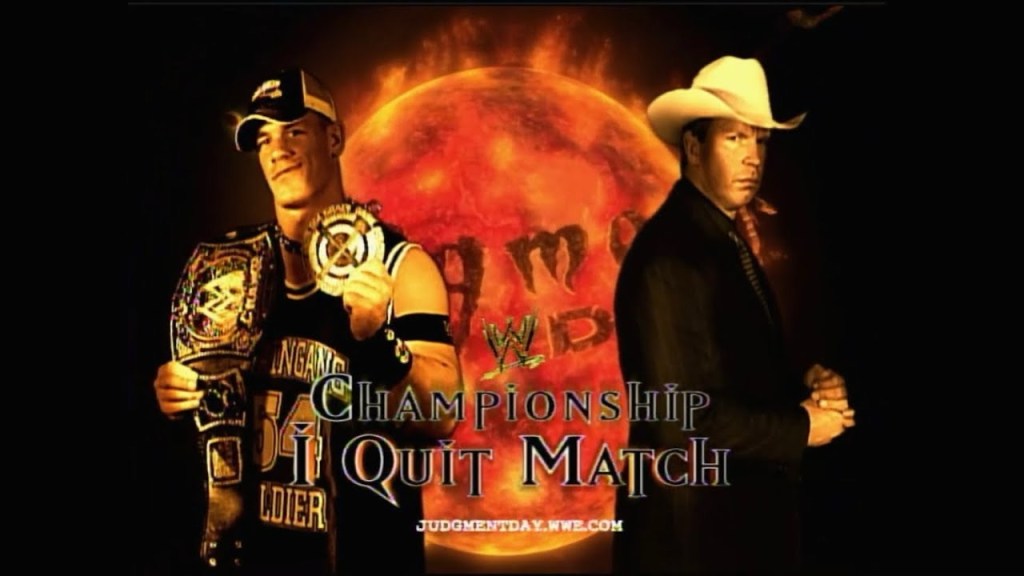
Editor’s Note: I’ll be reviewing the career of John Cena through various signature matches he’s had. I’m trying to create a career narrative for the Greatest of All Time – let’s go! Catch part 1 here.
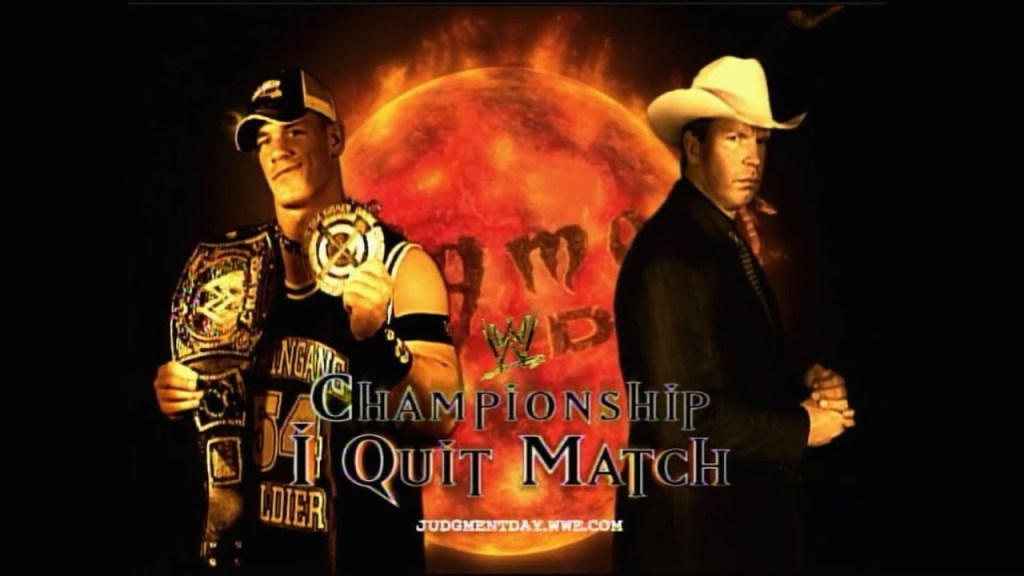
John Cena is now The Man (sorry, Becky Lynch). He’s released a CD, he’s making appearances at baseball games, he’s in movies – it’s clear that the WWE marketing machine is all-in on John Cena, whose hunger and passion have been fine-tuned into a confident performer who knows his strengths & uses them adeptly. He is the WWE Champion, complete with custom-made spinner championship belt, and it seems that the sky is the limit for the Chain Gang Soldier.
But the former champion, John “Bradshaw” Layfield (JBL), has hijacked the My Time is Now era by taking the original WWE Championship and calling himself the true champion. He was beat at WrestleMania 21, but not vanquished. So here, at Judgment Day 2005, we have ourselves an “I Quit” match between the new champion and the former champion who still thinks he’s champion.
In hindsight, we know that the “I Quit” match is John Cena’s signature match. His character would embody “Never Give Up” as a way of life, and the “I Quit” match is the very essence of such a character. This is Cena’s first “I Quit” match, and so I was keen to see how Cena would make this match type his own, what tropes we can point to him having innovated, and how influential this specific “I Quit” match is in the career of John Cena.
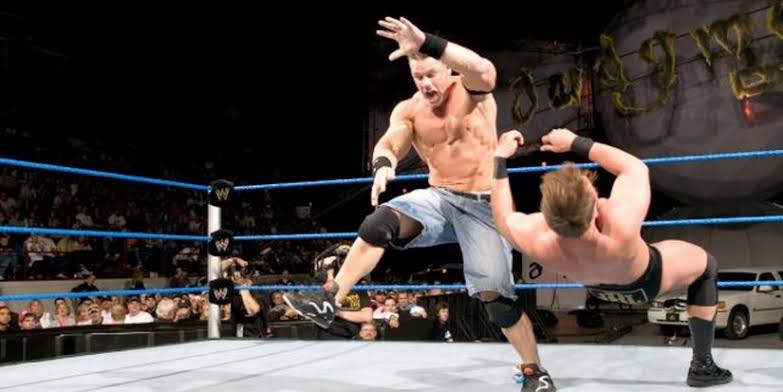
Commentary lets us know that the last “I Quit” match before this one was between Mankind and The Rock for the WWE Championship at Royal Rumble 1999. While that one is memorable for the vicious chair shots to Mick Foley’s head, this one is memorable for being the first modern WWE I Quit match. While Foley and Dwayne Johnson leaned into the intense nature of the stipulation (“beat another man down until he can no longer take the punishment”), Cena and Layfield went the other way – a plunder match with an ending that is somewhat comedic & which would influence so many “I Quit” matches going forward.
The story of the match was simple: JBL is taller than Cena. He weighs more. He’s a brawler. He is the quintessential ground-and-pound wrestler who has not one iota of high-flying in his body but who you can trust to win a street fight against anybody in existence. And Cena, a relatively new player in the main-event scene, had to deal with Bradshaw in a setting where anything goes. Could Cena overcome the odds? (You know where this is going).
This match was filled to the brim with memorable spots, including JBL about to powerbomb Cena on the announce table, and Cena saying “kiss my ass” into the mic before giving JBL a back body drop onto the other announce table. The “big power move as exclamation point to quippy one-liners” would be a staple in many of Cena’s “I Quit” matches (see the ending of Cena v. Batista, Over the Limit 2010). There was also the “walk-around-the-arena-and-punch-each-other” Attitude Era leftover which I don’t care for, but which Cena excels at – hitting Bradshaw with props conveniently in his line of sight is something Cena is underrated at doing well, and something every plunder match of his would feature.
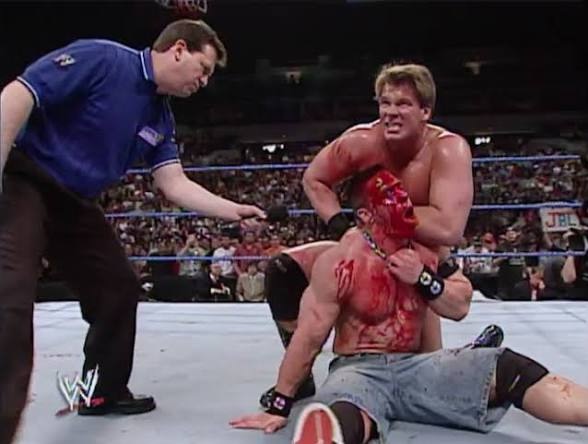
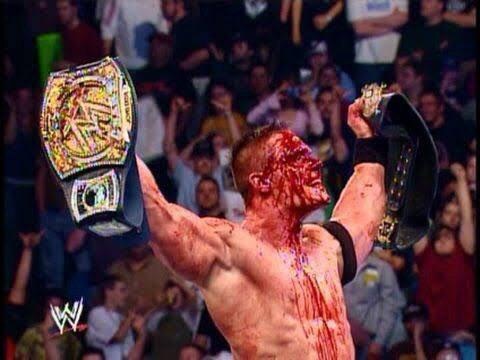
The heart of the match, though, is what we all remember: THE BLOOD. Cena bled buckets in this match, and his selling was perfectly in line with it. When JBL was choking Cena with his own chain, blasting him with Clothesline from Hell after Clothesline from Hell, the premise was clear: JBL as the big intimidating bully, and Cena as a vulnerable bloody mess who could barely even stand. Cross-footed, with a streak of fear and confusion in his eyes, almost like a child in way over his head, Cena was a delight here as the young champion in serious danger. The crowd, which was quiet for most of this match, came alive with CENA! CENA! CENA! chants.
We would return to plunder spots, with JBL’s limousine and Cena’s truck being used as props in very fun and ingenious ways. As someone who isn’t a fan of WWE plunder matches as they’re constructed, these were the weakest points of the match for me. I’m left feeling both surprised that even before the TV-PG rating in 2008 that the company’s plunder matches were so sterile, and disappointed that most of the match didn’t lock into these men’s strengths: their contrasting characters, exemplified by JBL beating the shit out of Cena who’d look increasingly vulnerable before finding a way to win.
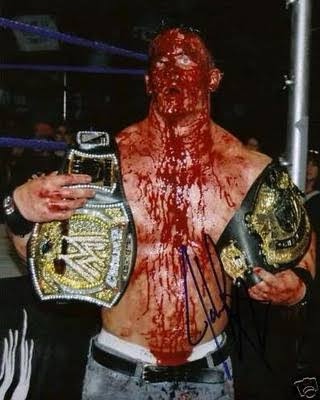
In any case, the match ends as Cena picks up a steel exhaust pipe from his truck, and plans to hit JBL with it through the Judgment Day set of glass. Bradshaw sees Cena’s intentions, and in an anticlimactic twist, says the dreaded words “ I QUIT”, and Cena retains the championship. Despite this, JBL smiles and points to his head, signalling that he was smart enough to avert disaster. Cena just blasts him with the pipe through the glass anyway, and celebrates in the ring with the two championships to close the show.
This spot would go on to be a staple of Cena “I Quit” matches, with his bout with Batista hitting exactly the same notes, and his heir-apparent as face of the company Cody Rhodes using the trope in his 2024 “ I Quit” battle against A.J Styles. This was an effective and emphatic match which did what it said on the tin – show the world that John Cena will lead this company into the future. If we judge the match by those metrics, it scores incredibly high. Beating top stars is how a star is legitimised in the wrestling business, and JBL was just one of many stars who’d look up at the lights as “My Time is Now” blared in the arena.
As an “I Quit” match?
Well…
If one wants to see the quintessential WWE I Quit match, you’d have to go to 2009, where Cena and Randy Orton battled at the Breaking Point pay-per-view. That encounter took the best part of this bout (where Cena was vulnerable, and getting beat on by his malevolent opponent) and made it the entire match. As a result, that match became one of the most celebrated and memorable Cena matches in his catalogue. While elements of it existed here, not enough of it was present to get the crowd into this match, or to maximise the personality clash between the characters.
This match then serves as a reference point in Cena’s career more than a complete unit in and of itself: remember when John Cena made JBL quit while his entire face and chest area were doused with his own blood? The match is a legitimiser for Cena, who’s able to end his feud with the man who’d held the WWE Championship longer than anyone in a decade by soundly defeating him in a match type synonymous with pain and resilience. It’s not a great match, but no matter, Cena would have dozens of far more excellent fights.
But as the parting shot from Michael Cole on commentary goes, “the time is now for the WWE Champion”. And that’s what it’s all about.
⭐️⭐️⭐️


Leave a comment